Showing posts with label music. Show all posts

2/19/2013

Garhwali songs

[ . BACK to WORLDKIGO TOP . ]
:::::::::::::::::::::::::::::::::::::::::::::::::::::::::::::::::::::::::::::::::::::::::::::::::::::

Garhwali songs

***** Location: India
***** Season: Topic
***** Category: Humanity


*****************************
Explanation

quote
The Garhwali language (गढ़वळि भाख/भासा)
is a Central Pahari language belonging to the Northern Zone of Indo-Aryan languages. It is primarily spoken by the Garhwali people (गढ़वळि मन्खि) who are from the north-western Garhwal Division (गढ़वाळ) of the northern Indian state of Uttarakhand in the Indian Himalayas.
. . . . . Garhwali is one of the languages which is shrinking very rapidly. UNESCO’s Atlas of the World's Languages in Danger designates Garhwali as a language which is in the unsafe category and requires consistent conservation efforts.

In the last few decades many Garhwali folk singers like Narendra Singh Negi, Pritam Bhartwan and many more have roused people’s interest in Garhwali language by their popular songs and videos. On average there is one movie in four or five years in Garhwali.
© More in the WIKIPEDIA !

:::::::::::::::::::::::::::::::::::::::::::::::::::::::::::::::::::::::::::::::::::::::::::::::::::


quote
Veteran Garhwali singer laments falling standard of folk songs
Uttarakhand is known for its culture, folk music, dance and other traditional practices. The folk music of Uttarakhand is a blend of nature and culture but today’s folk songs have lost the traditional essence as they are replete with cheesy lyrics and pop influences.

Nowadays songs such as namaste namaste, babli tero mobile and furki Band are dominating the market as they appeal to listeners not aware of Uttarakhand’s culture and more influenced by Punjabi pop and Hindi film music.

There was a time when Garhwali folk music had reached the national level with Garhwali folk singer Jeet Singh Negi whose compilation of six Garhwali songs was recorded on gramophone by HMV in 1949.
source : www.dailypioneer.com - 2012


Listen to some songs here :
- reference on YouTube


*****************************
Worldwide use


*****************************
Things found on the way


*****************************
HAIKU


Nodding in his plastic chair, the night watchman has a cell phone for company. I know the folk song playing on it is Garhwali and not from the mountains of Manipur or Peru only because Garhwal is where the watchman is from. The phone slips from his grip and falls on the ground, but the song goes on.

soon it will be spring –
a cricket adds its voice to
the night’s loneliness


Shared by Johannes Manjrekar
Haiku Culture Magazine - 2013


*****************************

Related words

. Music of India - Index .


[ . BACK to WORLDKIGO . TOP . ]
::::::::::::::::::::::::::::::::::::::::::::::::::::::::::::::::::::::::::::::::::::::::::::::::::::: 

10/30/2012

Bhajan music

[ . BACK to WORLDKIGO TOP . ]
:::::::::::::::::::::::::::::::::::::::::::::::::::::::::::::::::::::::::::::::::::::::::::::::::::::

Bhajan Hindu music

***** Location: India
***** Season: Topic
***** Category: Humanity


*****************************
Explanation

quote
Bhajan: Hindu Devotional Music
Music to human ears is heavenly. And if it's purely devotional, it's truly divine. Such a genre of music is the bhajan. Nothing can be more deeply rooted in the Indian tradition than bhajans. Bhajans are simple songs in soulful language expressing the many-splendored emotions of love for God, a complete submission or self-surrender to him through singing.

History and Origin
The groundwork for bhajans was laid in the hymns found in Sama Veda, the fourth Veda in the Hindu scriptures. They are distinguished from the Sanskrit shlokas (hymns that accompany religious rituals) by virtue of their easy lilting flow, the colloquial renderings and the profound appeal to the mass. These are sung in a group comprising devotees, with a lead singer. The fixed tunes, repetition of words and phrases lend a kind of tonal mesmerism. Anecdotes, episodes from the lives of Gods, preaching of saints, description of God's glories have been the subject of bhajans. Another form of the bhajan is the kirtan or songs in the Haridas tradition.

Great Exponents
The medieval age saw devotees like Tulsidas , Surdas, Meera Bai , Kabir and others composing Bhajans.

source : hinduism.about.com

:::::::::::::::::::::::::::::::::::::::::::::::::::::::::::::::::::::::::::::::::::::::::::::::::::


- Reference and youtube samples


*****************************
Worldwide use


*****************************
Things found on the way


*****************************
HAIKU


full moon bhajans
an organiser barks
into the mike


Shared by Johannes Manjrekar
Joys of Japan, October 2012


birdsong . . .
bhajans... and then
dawn grey


Shared by Johannes Manjrekar


*****************************

Related words

***** . Music from India .


[ . BACK to WORLDKIGO . TOP . ]
::::::::::::::::::::::::::::::::::::::::::::::::::::::::::::::::::::::::::::::::::::::::::::::::::::: 

8/21/2012

Damaru drum

[ . BACK to WORLDKIGO TOP . ]
:::::::::::::::::::::::::::::::::::::::::::::::::::::::::::::::::::::::::::::::::::::::::::::::::::::

Damaru drum, damru

***** Location: India
***** Season: Topic
***** Category: Humanity


*****************************
Explanation

quote
A damaru (Skt.damaru; Devanagari: डमरु) or damru
is a small two-headed drum, used in Hinduism and Tibetan Buddhism.


In Hinduism

The damaru is very common throughout the Indian subcontinent. The damaru is known as a power drum, and when played, it is believed to generate spiritual energy. It is associated with the Hindu deity Shiva. It is believed that Sanskrit language was recognized by the drumbeats of the damaru (see Shiva Sutra for the sounds), and His performance of the cosmic dance of tandava. The damaru is used by itinerant musicians of all stripes, due to its small portable size.

In the shield shape of some damarus, the triangular upward representation also symbolizes male procreativity (the Lingam), and the downward round representation symbolizes the female procreativity (the Yoni). Symbolically, the creation of the world begins when the lingam and yoni meet at the midpoint of the damaru, and the destruction takes place when they separate from each other.

Tibetan Skull Damaru
The skull (thöpa) damaru is made from a male and female skull bone or calvarium, cut well above the area of the ear, and joined at their apex.
© More in the WIKIPEDIA !


:::::::::::::::::::::::::::::::::::::::::::::::::::::::::::::::::::::::::::::::::::::::::::::::::::


Damru is one of the attributes of several deities and gods (of Hindus), particularly of Shiva. Damru is a small hourglass shaped drum, and is particularly associated with Shiva in his aspect as the Nataraja, performing the cosmic dance of tandava. The sound of damru represents the primeval sound and the rhythm from which, according to cosmology, the universe emerges and in which it dissolves into, before re-emerging again.

Indian Musical Instrument Damaru is the most common hour-glass drum in India. There are two drumheads on each side of the resonator which are laced together with cord. Near the centre of the lacing are two loose knoted cords. The knots on each end strike both heads to produce a rattling sound. This is affected by rotating the drum rapidly in alternating directions. The pitch is bent by squeezing the lacing.The damaru has very strong cultural associations. It is strongly associated with the God Shiva and sadhus ( Hindu religious men).

The Resonator is Made of brass and the height of Damru is around 6"
The weight of damru varies from 250-330 gms.
source : www.devshoppe.com


*****************************
Worldwide use


. Denden daiko でんでん太鼓 twist drum .


. Ritual Drums of Japan .


*****************************
Things found on the way


*****************************
HAIKU


the magician's hand
makes damaru beats ~
a monkey circles around


Shared by Sarbjit Singh Khaira
Joys of Japan, 2012


Look at a monkey performance here :
source : www.youtube.com


*****************************

Related words

. maizaru 舞猿 dancing monkeys .


[ . BACK to WORLDKIGO . TOP . ]
::::::::::::::::::::::::::::::::::::::::::::::::::::::::::::::::::::::::::::::::::::::::::::::::::::: 

8/19/2012

Raga Chandar Kauns

[ . BACK to WORLDKIGO TOP . ]
:::::::::::::::::::::::::::::::::::::::::::::::::::::::::::::::::::::::::::::::::::::::::::::::::::::

Raga Chandar Kauns

***** Location: India
***** Season: Topic
***** Category: Humanity


*****************************
Explanation

quote
RAG CHANDRAKAUNS (a.k.a. CHANDRAKOSH)

Chandrakauns is a very beautiful and striking rag. It is also surprisingly easy to perform. One should keep in mind, that there are actually two versions of Chandrakauns. There is an old obsolete version, and there is the modern version.

The name Chandrakauns is interesting. The prefix "chandra" means "moon". Although the etymology of the term "kauns" is obscure, it generally is used to represent five note rags. There are several forms of both pronunciation and spelling, Chandrakosh is the second most common pronunciation.

... For quite some time Chandrakauns has been a popular rag for the lahara. The lahara, also known as the naghma (nagma), is a repetitive melody used in the accompaniment of tabla solos and in kathak pieces. Bollywood in turn has picked up on this, and has further reinforced the association by frequently using Chandrakauns based laharas in scenes that depict traditional tawaifs (an Indian version of the geisha) and traditional kathak dances.

Look at more videos here :
source : chandrakantha.com


:::::::::::::::::::::::::::::::::::::::::::::::::::::::::::::::::::::::::::::::::::::::::::::::::::


Rag Chandrakauns - Full Moon
G.S. Sachdev
source : www.amazon.co.jp


:::::::::::::::::::::::::::::::::::::::::::::::::::::::::::::::::::::::::::::::::::::::::::::::::::

LISTEN !

Sitar Legend Pt. Ravi Shankar &
his lovely Daughter Anoushka


source : www.youtube.com


*****************************
Worldwide use


*****************************
Things found on the way


*****************************
HAIKU


lantern-lit night-
she whispers seven-notes
of moon-song


This work of mine is based on "RAGA CHANDAR-KAUNS"... in Sanskrit we call "CHANDAR" The" MOON"... all ragas are based on seven complete tones which we call SWARAS or "SARGAM"...
Sa - Re - Ga - Ma - Pa -Dha - Ni and followed by ( Sa) again for the next pitch-scale..the number of notes could vary, depends on the song... if you notice, in this painting there are seven tone holes in the flute, other than the embouchure hole (resting just in the moon).


chandar kauns -
echo of seven strings
outside the temple


Shared by Amrao Gill
Joys of Japan, 2012


*****************************

Related words

***** . Indian music {Raagam Music, Raga} .


. Music of India - Index .


[ . BACK to WORLDKIGO . TOP . ]
::::::::::::::::::::::::::::::::::::::::::::::::::::::::::::::::::::::::::::::::::::::::::::::::::::: 

8/01/2012

Music of India - Index

[ . BACK to Worldkigo TOP . ]
:::::::::::::::::::::::::::::::::::::::::::::::::::::::::::::::::::::::::::::::::::::::::::::::::::::

Indian Music - The Music of India

***** Location: India
***** Season: Non-Seasonal Topic
***** Category: Humanity


*****************************
Explanation


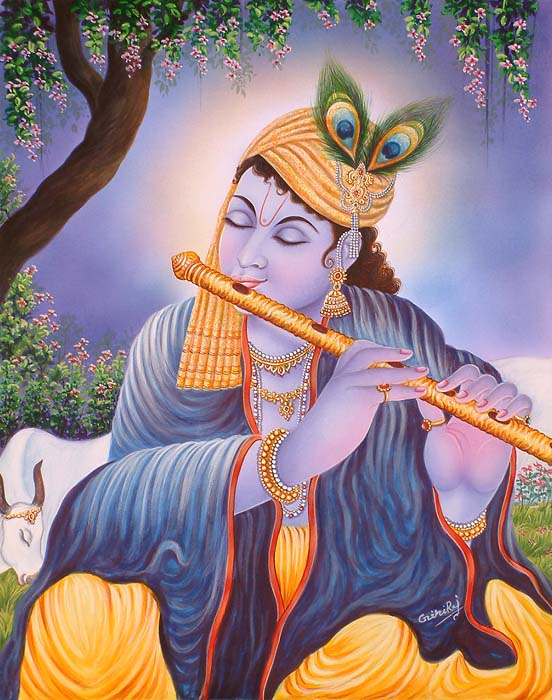
Lord Krishna playing the Flute
http://www.exoticindia.com/product/HC41

:::::::::::::::::::::::::::::::::::::::::::::::::::::::::::::::::::::::::::::::::::::::::::::::::::::

quote
The music of India
includes multiple varieties of folk, popular, pop, classical music and R&B. India's classical music tradition, including Carnatic and Hindustani music, has a history spanning millennia and developed over several eras. It remains fundamental to the lives of Indians today as sources of spiritual inspiration, cultural expression and pure entertainment. India is made up of several dozen ethnic groups, speaking their own languages and dialects, having distinct cultural traditions.

The two main traditions of classical music are
Carnatic music
, found predominantly in the peninsular regions, and
Hindustani music,
found in the northern and central regions.
© More in the WIKIPEDIA !


Carnatic music
(Sanskrit: Karnāṭaka saṃgīta) is a system of music commonly associated with the southern part of the Indian subcontinent, with its area roughly confined to four modern states of India: Andhra Pradesh, Karnataka, Kerala, and Tamil Nadu. It is one of two main sub-genres of Indian classical music that evolved from ancient Hindu traditions; the other sub-genre being Hindustani music, which emerged as a distinct form because of Persian and Islamic influences in North India. In contrast to Hindustani music, the main emphasis in Carnatic music is on vocal music; most compositions are written to be sung, and even when played on instruments, they are meant to be performed in gāyaki (singing) style.
© More in the WIKIPEDIA !


Hindustani classical music
(Hindi: हिन्दुस्तानी शास्त्रीय संगीत्, Urdu: کلاسیکی موسیقی) is the Hindustani or North Indian style of Indian classical music found throughout the northern Indian subcontinent. The style is sometimes called North Indian classical music or Shāstriya Sangeet. It is a tradition that originated in Vedic ritual chants and has been evolving since the 12th century CE, primarily in what is now North India and Pakistan, and to some extent in Bangladesh, Nepal and Afghanistan. Today, it is one of the two subgenres of Indian classical music, the other being Carnatic music, the classical tradition of South India.
© More in the WIKIPEDIA !


:::::::::::::::::::::::::::::::::::::::::::::::::::::::::::::::::::::::::::::::::::::::::::::::::::::


The music of India
includes multiple varieties of folk, popular, pop, classical music and R&B. India's classical music tradition, including Carnatic and Hindustani music, has a history spanning millennia and, developed over several eras, it remains fundamental to the lives of Indians today as sources of spiritual inspiration, cultural expression and pure entertainment. India is made up of several dozen ethnic groups, speaking their own languages and dialects, having very distinct cultural traditions.

source : www.customlabelmusic.com

:::::::::::::::::::::::::::::::::::::::::::::::::::::::::::::::::::::::::::::::::::::::::::::::::::::


Indian Music - Introduction

. by Narayanan Raghunathan .

. Raag[am] .

. Shruthi .

:::::::::::::::::::::::::::::::::::::::::::::::::::::::::::::::::::::::::::::::::::::::::::::::::::::


http://www.amazon.com/exec/obidos/tg/detail/-/B00000JT8Q/002-0838490-2675254?v=glance

SAROD

:::::::::::::::::::::::::::::::::::::::::::::::::::::::::::::::::::::::::::::::::::::::::::::::::::::

... ... ... Some external LINKS

Haiku and Indian Music
by Kala Ramesh
- Simply Haiku, August 2005 -
World Haiku Review, January 2007


Welcome - Music India OnLine

Introduction to North Indian Music

Rajan . P. Parrikar about Indian Music .. with many online samples


:::::::::::::::::::::::::::::::::::::::::::::::::::::::::::::::::::::::::::::::::::::::::::::::::::::

... ... ... Some famous musicians


M.S. Subbhulaksmi by Kala Ramesh

Ravi Shankar

Shobha Gurtu, a tribute by Kala Ramesh

Ustad Bismillah Khan

Ustad Vilayat Khan

to be continued


*****************************
Worldwide use


. Music and Haiku .


*****************************
Things found on the way


The Rhythm of Music -
A Magical and Mystical Harmony


The great god Shiva once chanced upon his wife Parvati reposing most gracefully. Her breathing was like soft music; the exquisite bosom rising and falling in rhythm. Her arms and wrists laden with bangles caused music by their motion. Shiva was intoxicated by this ravishing vision, and watched her for a long time in silence. Such was the impression created in his mind that he found no peace until he discovered a way of making a permanent record of the beauty observed.

The result was the veena (vina), a musical instrument, whose long neck represents the straight lithe form of Parvati, and the two supporting gourds her breasts, the metal frets her bracelets, and the most expressive of all, the sound generated by this instrument is said to recreate Parvati's own, rhythmic breathing.


Read an article by Nitin Kumar
http://www.exoticindia.com/article/music


:::::::::::::::::::::::::::::::::::::::::::::::::::::::::::::::::::::::::::::::::::::::::::::::::::::


Heavenly Musicians of Hindu Mythology

The Apsaras are female spirits of nature. They are considered very talented artistically, and all of them are described as being very beautiful. Apsaras love to dance, make music performe for gods.
While serving as inspiration for lovers, they were often sent by Ravana to tempt rishis or Brahmans who were retreating into the forest.

Apsaras in the Caves of Dunhuang, by Gabi Greve


*****************************
HAIKU


a cold evening
spend with warm thoughts -
Indian music


.

Indian music -
my cat purrs softly
in his dream

Gabi Greve with Cat Haiku Kun


:::::::::::::::::::::::::::::::::::::::::::::::::::::::::::::::::::::::::::::::::::::::::::::::::::::


- Music Haiku by Kala Ramesh -


malkauns in the air
moon in the bird-bath
self conscious!

Malkauns is a romantic night raag.

... ...

in concert -
fingers swirl on the tabla
pulsating rhythm


Tabla -  More in the WIKIPEDIA !


strains of the violin
- the old man walks
to his own rhythm


Indian music has very complex rhythmic calculations.

... ...

night air . . .
memory of the bamboo flute
long after the concert

long night . . .
sitarist strums
the sound of music


sitar baithak
my legs move
to rhythm


baithaks are house concerts where people sit on the floor in an informal fashion.


... ...


morning sparrows
on my window sill. . .
my song ends


sishya takes
the Guru gives . . .
the river gushes forward

Sishya means student and Guru means teacher.


MORE


. Kala Ramesh - a musician and haiku poet .


:::::::::::::::::::::::::::::::::::::::::::::::::::::::::::::::::::::::::::::::::::::::::::::::::::::


soft sitar notes -
more chatting , more tea
and more rain


- Shared by Rosie Mann -
Joys of Japan, 2012


Sitar -  More in the WIKIPEDIA !


*****************************
Related words

***** Raga Malhar, raag malhaar

Malhar is associated with the atmosphere of torrential rains.
According to the legend, Malhar is so powerful that when sung, rain falls from the sky.

There are many written accounts of Raga Malhar. Many great artists of medieval period and much earlier period used to sing this raga. Tansen, Baiju Bawra, Baba Ramdas, Nayak Charju, Miyan Bakhshu, Tantarang, Tanras Khan, Bilas Khan (son of Tansen), Hammer Sen, Surat Sen, and Meera are among the singers who are said to have been capable of starting rains using various kinds of Raga Malhar.
© More in the WIKIPEDIA !


pitter-patter rain -
aha! raag malhaar begins
without a sitar


- Shared by Mandeep Maan -
Joys of Japan, September 2012


:::::::::::::::::::::::::::::::::::::::::::::::::::::::::::::::::::::::::::::::::::::::::::::::::::::

***** . Bhajan Hindu Music .

***** . Garhwali songs .

***** . Raga Chandar Kauns, chandarkauns .

***** . Raga Kalyani, raga kalyaan .


.................................................................................


Instruments


***** . Damaru drum, damru .

***** . Tambura, tanbura lute .


:::::::::::::::::::::::::::::::::::::::::::::::::::::::::::::::::::::::::::::::::::::::::::::::::::::

A Glossary of Indian Music Terms

History of Hindustani Classical Music


Indian Musik : MORE LINKS
in the India Saijiki


[ . BACK to WORLDKIGO . TOP . ]
:::::::::::::::::::::::::::::::::::::::::::::::::::::::::::::::::::::::::::::::::::::::::::::::::::::
7/19/2012

Kalyani (raga)

[ . BACK to WORLDKIGO TOP . ]
:::::::::::::::::::::::::::::::::::::::::::::::::::::::::::::::::::::::::::::::::::::::::::::::::::::

Kalyani (raga)

***** Location: India
***** Season: Topic
***** Category: Humanity


*****************************
Explanation

We have two systems of classical music in India.
One is the North Indian classical ( Hindustani classical) and the other is the
South Indian classical traditions ( called Carnatic Classical).

In both some ragas are the same, Kalyan ( Hindustani) and
Kalyani (Carnatic) are both the same raga. A romantic raga which is / should be sung only late evenings. Hindustani classical strictly follows the theory of time and season.

We can't sing a morning raga in the evening and a night raga can only be sung or played at night. We have ragas that are for spring, hot seasons, monsoons etc etc . . .

The theorists believe the raga gets its full potential only when sung, played or listened during the time it is allotted. But not always is that possible. Plus you need to have the whole chart of ragas ( several hundreds - each having their own time slot etc etc!) can be too confusing for a lay person.

Kala Ramesh

:::::::::::::::::::::::::::::::::::::::::::::::::::::::::::::::::::::::::::::::::::::::::::::::::::::


Kalyan or Kalyani, originally called Yaman,
is a melakarta rāga (parent musical scale) in the Carnatic music of South India, and is also an important raga in Hindustani (North Indian) music. Its Western equivalent is the Lydian mode.
© More in the WIKIPEDIA !


Indian Classical Raag Kalyan (Bandish and Taane)
on Acoustic Guitar and Tabla
source : www.youtube.com


*****************************
Worldwide use


*****************************
Things found on the way


*****************************
HAIKU


raga kalyaan
a pumpkin gourd
yields the autumn lyric


_kala


*****************************

Related words


. Music of India .


[ . BACK to WORLDKIGO . TOP . ]
:::::::::::::::::::::::::::::::::::::::::::::::::::::::::::::::::::::::::::::::::::::::::::::::::::::

7/03/2012

Japji Sahib hymns

[ . BACK to WORLDKIGO TOP . ]
:::::::::::::::::::::::::::::::::::::::::::::::::::::::::::::::::::::::::::::::::::::::::::::::::::::

Japji hymns (Jabji hymns)

***** Location: India
***** Season: Topic
***** Category: Humanity


*****************************
Explanation

quote
Japji is a universal song of God
composed by Guru Nanak Dev, the founder of the Sikh faith.

Japji Sahib consists of the Mool Mantra as the beginning followed by 38 hymns and a final Salok at the end of this composition. The Japji appears at the very beginning of the Guru Granth Sahib, the Holy Book of the Sikhs. It is regarded as the most important Bani or 'set of verses' by the Sikhs and is recited every morning by all practising this faith. The word ‘Jap’ means to ‘recite’ or ‘to ‘chant’. ‘Ji’ is a word that is used to show respect as is the word ‘Sahib’. 'Ji' can also be used to refer to one's own soul.

This Bani was composed by the founder of the faith, Sri Guru Nanak Dev, who was the first of ten Sikh Gurus. The Ten Gurus of Sikhism were responsible for the creation of this faith which took place over period 1469 to 1708 – a period of about 239 years. At the point when the last of these Gurus departed this Earth, the Guruship was passed to the Sikh Holy Book, the Guru Granth Sahib. The Sikh treat the Guru Granth Sahib as a living Guru and the respect shown for the Shabad or
‘Message of the Gurus’ is unique in the faith.
© More in the WIKIPEDIA !


:::::::::::::::::::::::::::::::::::::::::::::::::::::::::::::::::::::::::::::::::::::::::::::::::::


Japji Sahib
Listen to samples on YouTube:
source : www.youtube.com


*****************************
Worldwide use


*****************************
Things found on the way


*****************************
HAIKU


reading Japji Sahib -
a bumblebee
bothers me


Shared by Manu Kant

Joys of Japan, 2012


:::::::::::::::::::::::::::::::::::::::::::::::::::::::::::::::::::::::::::::::::::::::::::::::::::::


morning sun
pours down on her face ~
Japji hymns


Shared by Sandip Sital Chauhan
Joys of Japan, 2012


*****************************

Related words

***** . Haiku from Punjab .


[ . BACK to WORLDKIGO . TOP . ]
:::::::::::::::::::::::::::::::::::::::::::::::::::::::::::::::::::::::::::::::::::::::::::::::::::::

6/12/2012

Gurbani hymns

[ . BACK to WORLDKIGO TOP . ]
:::::::::::::::::::::::::::::::::::::::::::::::::::::::::::::::::::::::::::::::::::::::::::::::::::::

Gurbani hymns

***** Location: India
***** Season: Topic
***** Category: Humanity


*****************************
Explanation

quote
Gurbani (Punjabi: ਗੁਰਬਾਣੀ)
is the term used by Sikhs to refer to any compositions of the Sikh Gurus.
Gurbani is composed of two words: 'Gur' meaning 'the Guru's' and 'bani' meaning 'word'.

Extracts from Sri Guru Granth Sahib ji are called Gutkas (small books) containing sections of Gurbani.


Nitnem Banis
The Banis Japji Sahib, Jaap Sahib, Tav-Parsad Savaiye, should be read daily according to the Sikh Rehat Maryada. These are recited by initiated Sikhs in the early morning (before 6am). Rehras Sahib is read in the evening (at sunset) and Kirtan Sohila before going to sleep at night.
© More in the WIKIPEDIA !


:::::::::::::::::::::::::::::::::::::::::::::::::::::::::::::::::::::::::::::::::::::::::::::::::::


Sab Gobind Hai

ੴ ਸਤਿਗੁਰ ਪ੍ਰਸਾਦਿ ॥ੴ सतिगुर प्रसादि ॥
One immutable OM.
By The Grace Of The True Guru:


ਆਸਾ ਬਾਣੀ ਸ੍ਰੀ ਨਾਮਦੇਉ ਜੀ ਕੀआसा बाणी स्री नामदेउ जी की
Aasaa, The Word Of The Reverend Naam Dayv Jee:


ਏਕ ਅਨੇਕ ਬਿਆਪਕ ਪੂਰਕ ਜਤ ਦੇਖਉ ਤਤ ਸੋਈ ॥ एक अनेक बिआपक पूरक जत देखउ तत सोई ॥
In the one and in the many,
He is pervading and permeating;
wherever I look, there He is.


Continue here :
source : gurbanee.blogspot.jp


*****************************
Worldwide use


*****************************
Things found on the way


*****************************
HAIKU


moonlight shines
through the broken window -
Gurbani hymns


Shared by Sandip Sital Chauhan
Joys of Japan, 2012


*****************************

Related words

***** . Haiku from Punjab .


[ . BACK to WORLDKIGO . TOP . ]
:::::::::::::::::::::::::::::::::::::::::::::::::::::::::::::::::::::::::::::::::::::::::::::::::::::

12/30/2006

Kala Ramesh

[ . BACK to WORLDKIGO . TOP . ]
::::::::::::::::::::::::::::::::::::::::::::::::::::::::::::::::::::::::::::::::::::::::::::::::::::: 
Kala Ramesh

*****************************

Kala Ramesh has pursued her Bachelor of Arts from Chennai with a combination of History, Political Science and English Literature.

Kala has long had a fascination for Indian classical music and is an exponent of both Carnatic and Hindustani Classical Music styles. She was fortunate to undergo vigorous training from leading musicians. She has worked extensively on Pandit Kumar Gandharava’s compositions and Nirguni bhajans along with the paramparic bandishes of the Gwalior Gharana, under the guidance of Vidushi Smt Shubhada Chirmulay, Pune.

Kala has made a concerted effort to understand the ‘spirit’ behind Kumarji’s gayaki – incorporating the vigour and the vitality, which is so inherent in his style of singing and she has performed in major cities in India.

A recently turned haiku poet in 2005, Kala has won three prestigious awards – The Heroin’s Nest Award (Spring ’06) and Vancouver Cherry Blossom Festival - Haiku Invitational 2006, Top 30 Haiku and placed 5th in the 4th Annual Poets' Choice Kukai Results in the free format entry. Her work consisting of haiku, tanka, senryu & haibun has appeared in leading e-zines and anthologies.

She comes from an extremely artistic and culturally rich South Indian family and believes -- as her father is fond of saying -- that "the soil needs to be fertile for the plant to bloom" and feels that she owes this poetic streak in her to her mother. A proud mother of two young adults, Kala lives with her husband, a finance professional, in Pune, India.


:::::::::::::::::::::::::::::::::::::::::::::::::::::::::::::::::::::::::::::::::::::::::::::::::::::

. Performance of Kala Ramesh and her troupe
at Prithvi Theatre, February 2006 .


xxxxxxxxxxxxxxxxxxxxxxxxxxxxx

Anu-naad (Resonance)
March 5, 2005

Read more of her poetry here:
http://www.narthaki.com/info/articles/art134.html


xxxxxxxxxxxxxxxxxxxxxxxxxxxxx

step after step
nature tells
her story


Kondane Caves by Kala Ramesh, India.
Published in simplyhaiku winter 2005


xxxxxxxxxxxxxxxxxxxxxxxxxxxxx

compare and contrast
October 2006

India is known for its famed RASA theory. Roughly translated - you could say Rasa is emotion

The Nava Rasa so to speak - has been extensively spoken about in the Bharata Shastra. In music we use only 4 or 5 of these rasas - the nine rasas are more prevalent in dance and drama

From Rasa comes the word Rasika [connoisseur] one who enjoys a rasa.
To understand any art form we need to develop that keen sense of Rasa. How does one develop it?
By critically evaluating art

Every time I write - I know deep within me, that all that I write are not good. And after a few days when I read my poems again - I enjoy a few . . .
Constant comparing and contrasting the poems within your own creation is one sure way of developing this critical appreciation?

I’ve heard many people say that their compositions are like their kids, to them - each is precious - each is good

How can that be?
That means we are allowing our ego to dominate our work?
If even for a moment if one could distance themselves from their work - and look at it objectively, critically, one would know that all poems are not of the same quality? It cannot be!

If one develops this keen awareness - one improves in bounds and leaps and there is no stopping them.

Self critical analysis is the key note then- which begins with comparing and contrasting.
I've been associated with Indian arts for years now - and this is what my teachers have told me for years. . . and they can't be wrong?

Comparing two musicians is odious but comparing my raga delineation today with what i sang a week back is critical appreciation.

xxxxxxxxxxxxxxxxxxxxxxxxxxxxx

... Creation and Silences ...

At India Nest Com, September 29, 2005
http://www.boloji.com/culture/006.htm

xxxxxxxxxxxxxxxxxxxxxxxxxxxxx

And what is spirituality in music?

Perfection is like a horizon, the closer you go towards it, the further it moves away.

Read the full article here:
http://www.artindia.net/kala1.html

xxxxxxxxxxxxxxxxxxxxxxxxxxxxx

A moot point

Out of sheer nothing
the musician
begins her sculpture.


Read the whole poem here:
http://www.narthaki.com/info/articles/art137.html

xxxxxxxxxxxxxxxxxxxxxxxxxxxxx

Haiku and Indian Music

Read more of her haiku about this subject here at Simply Haiku
http://www.poetrylives.com/SimplyHaiku/SHv3n3/showcase/kala_ramesh_IndianMusic.html

xxxxxxxxxxxxxxxxxxxxxxxxxxxxx

Shobha Gurtu
a tribute by Kala Ramesh


:::::::::::::::::::::::::::::::::::::::::::::::::::::::::::::::::::::::::::::::::::::::::::::::::::::


HAIKU

dripping mist
pulls the sky
into the valley


Bottle Rockets –fall 05
---------------------


spring breeze-
I catch the tune
she leaves behind


Heron’s Nest Award – Summer – 06
---------------------


forest walk-
a spider's shadow
climbs the tree


Asahi Shimbun - 05
-----------


winter loneliness:
the sofa she vacates
holds her shape


Bottle Rockets – fall 06
-------------------------------


our home
locked for a year . . .
spring breeze


Asahi Shambun - 06
---------------------


summer thunder
stepping out with bare feet
my soul


Asahi Shinbun- Sep 06
Says Editor, David McMurray at the International Herald Tribune/Asahi Shimbun- Tokyo -
Indian poet Kala Ramesh also tries deductive reasoning in the next poem about baring one's soul. An intended pun can be found in the similar sounding word, sole

---------------------


winter rain
colder than ever
this bowl of rice


Tempslibres - Oct 06
---------------------


the smile
lost in her wrinkles—
deep autumn


heron’s nest – fall 06
---------------------


temple gate-
the breeze gets in faster
than the devotees


tinywords – 30 Aug 06
---------------------


day breaks
the stars abandon
the moon


clouds peak – summer 06
---------------------


the year passes
weaker than my heart
my knees


Mainichi Daily News– Dec 06
---------------------


herbal massage-
I inhale the warm breath
she exhales


Frogpond - winter 07 issue
---------------------


a resonant call
from a sparrow’s tiny lung
basant


basant – spring in India , is also an Indian raga[ melody]
Simply Haiku -05
---------------------


the moving hand
holds high in music
the perfect sur


sur- means pitch
Simply haiku - 05
---------------------


wave-calls
haunting melodies linger
in mind’s abyss


Simply haiku -05
----------------------------


leaves glimmer--
dripping in malhaar tans
the raga


malhar – a monsoon raga
raga- an Indian melody
taans - fast passages sung to tabla

Simply Haiku -05
----------------------


deep in raga
a sudden applause
startles the singer


India Saijiki -06
---------------------


dance recital:
long plaited hair in step
with her hips


Haiku Harvest - 06
------------------


temple gate--
a blind beggar's pail fills
with blossoms


5th in the 4th Annual Poets' Choice Kukai Results
in the free format entry

--------------------


the butterfly
touches me
with her orange color


tinywords -05
----------------------


mango blossoms
here there everywhere
childhood memories


tinywords -06
----------------------


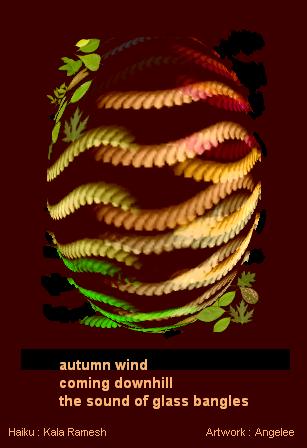
autumn wind -- coming downhill the sound of glass bangles


Illustration by Dr. Angelee Deodhar
Mainichi Daily News- Oct 06
----------------------------


slipping in
beneath the kitchen door--
first sunlight


Clouds peak -06
--------------------


cyclonic rains:
the branches take the cobweb
for a swing


Simply Haiku - 05
---------------------------------------


autumn dusk—
the hill gradually slopes
toward city din


Heron’s Nest –Spring 06
------------------------


the year passes
weaker than my heart
my knees


Mainichi Daily News–Dec 06
--------------------------


the lantern?
a strong wind
parts her hair


Asahi Shimbun – Dec 06
------------------------


autumn morning
passengers in the train
behind their newspapers


Heron’s Nest – December - 06
---------------------------


autumn lyrics
Father talks gently of life
beyond death


Tinywords – Nov, 06
-------------------------------


new year’s eve-
all that I could have left
unsaid . . .


:::::::::::::::::::::::::::::::::::::::::::::::::::::::::::::::::::::::::::::::::::::::::::::::::::::


HAIBUN


AN HOUR PASSES


And so, an hour passes . . .

dead body . . .
only the shadows of leaves
dance on her face


My wife died - thirteen days back. To be single again-it's a strange feeling that after sixty-six years of togetherness, I am all alone.

Like the River Cauvery that swells in the monsoons then becomes so thin that it seems almost like a drawn line, my family was huge once when my five children were small - kids take wing and slowly my wife and I grew accustomed to being by ourselves.

My son and my daughter-in-law insist that I will feel miserable in London. I keep telling them that I am ready to go with them. My daughter-in-law says "But papa, you have your temple, your friends here. What will you do there? It's a foreign country papa, try to understand."

How can I tell her that I am scared of staying alone? Won't my grandchildren laugh at me?

sultry morning
the chameleon changes
its colours


First published in Simply Haiku - Autumn 2005, vol 3 no 3
----------------------------------------------------------


ANAMIKA


she smiles--
as the baby turns
in her womb

The first two being daughters, my parents had only the names of boys ready-I was born a third girl. Some suggested that I be named Savitri-then the next would be a boy, they said. My aunt suggested Lavanya Latha-to add to the confusion. Dr. Raman [my father's college mate] who attended to my delivery, was invited for the naming ceremony-the name not yet chosen.

the bee . . .
buzzing in and out
unaware of me


She came and suggested that I be named Kala, the day being Saraswathi Pooja, the 9th day of Navarathri-a nine-day festival celebrated throughout India. Now, I have all three names-from no name to too many?

a sparrow:
on the ledge answers
to my whistle


Anamika - in Sanskrit means "one without a name".
Hindus believe that boys alone carry the lineage ahead, as girls get married into another family-so a male child becomes imperative
Kala meaning "art" in Sanskrit, is another name for Goddess Saraswathi who is worshipped as the Goddess of Learning.The ninth day of Navarathi is celebrated as the day of Saraswathi Pooja.


First published in Contemporary Haibun online - Fall Issue 2005, vol 1 no 3
---------------------------------------------------------


NAME GAME

owl's eyes
on the moth-
winks as she flies

A class of 63 pre-nursery toddlers, all present-each child with pet names like Bubblu, Twinkle, Kitta, Chinnu, Sweety and so on. . . I get a stiff back bending down to read their school names pinned on to their shirts-names which they themselves are not aware of . . .
Is there no better way?

just divorced-
my new sense
of obscurity


First published in Frogpond --- winter issue Feb 06


:::::::::::::::::::::::::::::::::::::::::::::::::::::::::::::::::::::::::::::::::::::::::::::::::::::


London morning dew -
fumes through my nostrils and mouth
like an Eastern dragon !


Artwork by Angelee Deodhar

:::::::::::::::::::::::::::::::::::::::::::::::::::::::::::::::::::::::::::::::::::::::::::::::::::::


Haiku Blossoms in Indian Music and Dance


twilight
on my lighted lamp—
autumn hues


An auspicious occasion in India generally begins with lighting the traditional bronze lamp with wicks on all five sides. The prayer song, invoking the blessings of Lord Ganesha, the remover of obstacles or Goddess Saraswati, the mother of all arts and learning, sets the mood for a grand opening.

Read it all HERE
Simply Haiku, August 2007

:::::::::::::::::::::::::::::::::::::::::::::::::::::::::::::::::::::::::::::::::::::::::::::::::::::


Three Haibun

Muse India Poetry Contest 2008
Certificate of Merit


Kala Ramesh – Renku 'Uncrumpled Wings'


:::::::::::::::::::::::::::::::::::::::::::::::::::::::::::::::::::::::::::::::::::::::::::::::::::::


morning raga
a honey bee attempts
to waken the bud


Read more :
source : www.museindia.com


raga kalyaan
a pumpkin gourd
yields the autumn lyric


:::::::::::::::::::::::::::::::::::::::::::::::::::::::::::::::::::::::::::::::::::::::::::::::::::::


The latest news about

KALA RAMESH


_kala, her haiku pen name


:::::::::::::::::::::::::::::::::::::::::::::::::::::::::::::::::::::::::::::::::::::::::::::::::::::

BACK to

. The Music of India - Index .

The Haiku Scene of India


[ . BACK to WORLDKIGO . TOP . ]
::::::::::::::::::::::::::::::::::::::::::::::::::::::::::::::::::::::::::::::::::::::::::::::::::::: 

8/01/2006

Tambura, tanbura

[ . BACK to WORLDKIGO TOP . ]
:::::::::::::::::::::::::::::::::::::::::::::::::::::::::::::::::::::::::::::::::::::::::::::::::::::

Tambura, tanbura

***** Location: India
***** Season: Topic
***** Category: Humanity


*****************************
Explanation

The tambura, tanpura, tamboura or taanpura
is a long-necked plucked lute (a stringed instrument found in different forms and in many places). The body shape of the tambura somewhat resembles that of the sitar, but it has no frets – and the strings are played open. One or more tamburas may accompany other musicians or vocalists. It has four or five (rarely six) wire strings, which are plucked one after another in a regular pattern to create a harmonic resonance on the basic note (bourdon or drone function).
An electronic tanpura is often substituted in contemporary Indian classical music performance.

The name tanapura is probably derived from tana, referring to a musical phrase, and pura, which means "full" or "complete".


Tamburas come in different sizes and pitches: larger "males", smaller "females" for vocalists, and a yet smaller version is used for accompanying sitar or sarod, called tamburi or tanpuri.
The male instrument has an open string length of approximately one metre; the female is three-fourths of the male.

Tamburas are designed in three different styles:
Miraj style
Tanjore style
Tamburi
© More in the WIKIPEDIA !

:::::::::::::::::::::::::::::::::::::::::::::::::::::::::::::::::::::::::::::::::::::::::::::::::::

*****************************
Worldwide use


*****************************
Things found on the way


*****************************
HAIKU


tanpura sound ripples
in widening circles---
music room


Kala Ramesh

Haiku and Indian Music
source : Simply Haiku, Autumn 2005


*****************************

Related words

. Indian Music - The Music of India .


[ . BACK to WORLDKIGO . TOP . ]
::::::::::::::::::::::::::::::::::::::::::::::::::::::::::::::::::::::::::::::::::::::::::::::::::::: 

7/08/2006

Shobha Gurtu Musician

[ . BACK to WORLDKIGO . TOP . ]
::::::::::::::::::::::::::::::::::::::::::::::::::::::::::::::::::::::::::::::::::::::::::::::::::::: 


This is an offering - a tribute - to one of India's renowned Thumri singer - Smt Shobha Gurtu,
who passed away in 2004

By Kala Ramesh

i enter her room. there she is. i have heard her voice. can recognize it even in deep sleep.
her ability to emote, portray shades of meaning in anything she sings.
a thumri. a dadra. a kajri. a bhajan.
abhinaya in those vocal cords.
a balasaraswathi, a kalanidhi narayan in a different mode.

a pukar here [a call and yearning] a taasir there [a compelling quality], laced with a deep anu - naad [resonance]
how does she do it? how effortless and easy it seems.
it seems.
i soon realized that beneath the simplicity of her gayaki [style] lies her virtuosity.
her meticulous search for that perfect swara [musical note]

swa means self and ra means light or to bring forth, meaning when the musician touches her 'soul' that music we say is 'felt' and when that happens, the song becomes rasavant [having essence] and is there for all to see.
a long journey.
no doubt.

on april 6th 2003, i went to smt shobha gurtu ji and asked her if she could teach me. the next day i began my lessons.
i had taken some apples with me.
she looked at them.
she took one in her hand.
''a slender stalk but what a huge fruit,
like a slender throat & a big voice'' . . . she said smiling.

then, the tabaliya started to play a simple teental,
she began to sing a bandish ki thumri,
chathiya tharaka gayi re mori aali, piya nahi aaya . . . . . . .

shobha ji came ALIVE.
her limbs moved. her body swayed. her eyes danced. her music weaved through the taal, joining the beat now, going off beat again, teasing, just like the ganga playing hide and seek with the himalayas

i sat at her feet mesmerized.

Now.
She is no more with us.
And I need to say this. She was a performer par excellence.

.............................

Balasaraswathi & Kalanidhi Narayan
both great Bharatnatyam dancers known for their Abhinaya. [dramatization of the nine emotions - the navarasas]

.............................

moving hand
holds high in music
the perfect sur


sur - means pitch. For the singer, the hand moves aiding the singing voice.


leaves glimmer
drips in malhar taans
the raga


malhar is a monsoon raga and taans are fast passages sung with a percussion - tabla
raga meaning passion - is a type of melody in Indian classical music.


taanpura sounds
ripples in widening circles . . .
music room

taanpura is an instrument used by vocalist in Indian classical music.

All above haiku first published in Simply haiku - 05.

Kala Ramesh


:::::::::::::::::::::::::::::::::::::::::::::::::::::::::::::::::::::::::::::::::::::::::::::::::::::

Remembering Shobha Gurtu - The 'Thumri Queen'
The 'Thumri Queen' passes away: Shobha Gurtu (1925 - 2004).


Noted vocalist Shobha Gurtu died at her Worli residence in central Mumbai on September 27, 2004, following a cardiac arrest. She was 78. Known as the ‘Thumri Queen’, Gurtu's career spanned over five decades.

Born in Belgaum in 1925, Shobha Gurtu hailed from a family in which melody ruled and rhythm had a shrine. She received her initial lessons in music from her mother Srimati Menakabai Shirodkar, a noted dancer of her time who also was trained in vocal music in the Atrauli Jaipur ‘Gayaki’ of Ustad Alladiya Khan. Later, Shobha had the privilege of receiving advanced training from Ustads of the eminence of Nathan Khan, in classical singing, and Ghamman Khan, in light classical and popular music. Her father-in-law, Pandit Narayan Nath Gurtu, the erudite scholar and musician, also gave her valued guidance and direction in her pursuit of music.

The grand dame of Thumri was thoroughly steeped in pure Classical Music. But she was better known for her light Classical Music. Shobha Gurtu was considered to be in a class by herself not merely because of the unique qualities of her warm and sensuous voice that blended strength with suppleness and vigour with grace. It was equally much the unique combination of talent and soul that she brought to bear on her music. She evolved a technique that let her negotiate, with equal ease, everything from thumri, dadra, hori, kajri and chaiti to ghazal, bhajan and Marathi Natya Sangeet, with all regional and stylistic variations blended subtly.
http://www.itcsra.org/sra_news_views/orbituary/shobha_gurtu.html

*****************************
Related words

***** Back to Music of India Indian Music and Haiku


[ . BACK to WORLDKIGO . TOP . ]
::::::::::::::::::::::::::::::::::::::::::::::::::::::::::::::::::::::::::::::::::::::::::::::::::::: 

6/21/2006

Music Narayanan Intro

[ . BACK to TOP . ]
:::::::::::::::::::::::::::::::::::::::::::::::::::::::::::::::::::::::::::::::::::::::::::::::::::::

Indian Music

by Narayanan Raghunathan


Indian Classical Music is a Vast Ocean considered to be Anaadi { Beginningless]

Revelations by tradtionalists. Shruthi, Raag[am], and Thaala{m], are the three major aspects of Indian Classical Music. Shruthi may be roughly called the Drone! Shruthi in Sanskrit { and in many Indian Languages ] means A Revelation heard.

Rig Yajur Saama and Atharva are the four Vedas [ vid ~ to Know ] Revealed and hence Shruthi. In Indian music Tampura (Tanpura) plays the Shruthi. It may be roughly treated as a static cord in western music terminology.

The Saptha Swaras [ The seven basic notes ] make the Raag[am]. But the Raaga or Raagam is not simply an ascending and descending scale of fixed notes. It has a unique Bhaavam[ Mood Expression, Life]. There are Innumerable Raagam[s].

Thaal[am] is the Rhythmic Gait [ Beat roughly ]
But unlike western beats which are near here cyclic rhythms are used, which in extravagant theoretical way we can assert there are infinite Thaal[am]s. But then few finite easy ones are practised generally.

Technically twenty two Shruthis are practised. Or basic drone pitch.
There are two very major distinct styles of Indian Classical Music practised.
Karnaatik [South Indian] and Hindusthani [ North Indian].

The Hindusthani music has two major branches the older traditional "Dhrupad" style and the later "Khayaal" style. The semi-neo classical Thumri, Ghazal, Tappa Tarana, Quwaali etc. are secondary off shoot genres. Bhajans are a traditional genre sung in Dhyaana[m] and prayer.
All these use the Raag[am] and Thaal[am].

Raag [ Hindusthani ] Raagam [ Karnaatik ] , Raga ~ This word can variously mean colour, design, symmetry, organization. desire, etc ~

Thaal [ Hindusthani ] Thaalam { Karnatik } ~ Is Rtam Rhythm. That which is intrinsic to things.

The music exists in reference in the Indian Religio-mystic context as "Naada Brahman."
"Naada" is eternal indivisible resonant sounds soaked in innumerables silences.

Brahman is All this and Not All This.
The Turiya Awastha and Aum [Pranava] too.

Here are some of the topics that will be covered separately.

1] Raag[am]
2] Taal[am]
3] Shruthi
4] Pallavi
5] Anu Pallavi
6] Charanam
7] Geetham
8] Karnaatik
9] Hindusthani

10 ] Dhrupad
11 ] Khayaal
12 ] Vilambit
13 ] Dhrut
14 ] Arohana[m]
15 ] Avarohana[m]
16 ] Layam.
17 ] Aavarthanam
18 ] Thani Aavarthanam
19 ] Thumri

20 ] Ghazal
21 ] Thaanam
22 ] Taan
23 ] Gharaana
24 ] Swara[m]
25 ] Krithi
26 ] Keerthanam
27 ] Bhajan[ai]
28 ] Sahithy[am]
29 ] Naadam

30 ] Brahman
31 ] Naada Brahma[n]m
32 ] Naatya
33 ] Nrittha
34 ] Naatya Shaasthram
35 ] Maatra
36 ] Mudra
37 ] Bhaava
38 ] Rasa
39 ] Nava Rasa

40 ] Karana
41 ] Bharatha Muni
42 ] Bharatha Naatyam
43 ] Kathak
44 ] Odissi
45 ] Kathakali
46 ] Mohinyaattam
47 ] Koodiyaattam
48 ] Yaksha gaana
49 ] Manipuri

50 ] Sitar
51 ] Veena
52 ] Bansuri
53 ] Sarod
54 ] Shehnai
55 ] Naagaswaram
56 ] Gottu Vaadyam
57 ] Mridangam
58 ] Pakhawaj
59 ] Tabla

60 ] Chenda
61 } Maddalam
62 ] Edaykka
63 ] Udukku
64 ] Abhoga
65 ] Alamkara
66 ] Antara

Narayanan Raghunathan
2006

:::::::::::::::::::::::::::::::::::::::::::::::::::::::::::::::::::::::::::::::::::::::::::::::::::::


BACK TO

. Music of India .


[ . BACK to WORLDKIGO . TOP . ]
:::::::::::::::::::::::::::::::::::::::::::::::::::::::::::::::::::::::::::::::::::::::::::::::::::::

1/21/2006

rAga Narayanan

nnnnnnnnnnnn TOP nnnnnnnnnnnnn

rAga

by Narayanan Raghunathan

The A signifies a length in pronunciation, also written raaga. The same goes for O meaning oo and E meaning ee. This spelling is used in musical sites.

:::::::::::::::::::::::::::::::::::::::::::::::::::::::::::::::::::::::::::::::::::::::::::::::::::::

rAg in HindusthAni music
rAga(m) in KarnAtik music


rAgam anAdi rahasyam parabrahma shruti tatvam

[rAga is pre-primordial sacred secret parabrahman’s revelatory essences ]

rAgam nitya shruti mantram Ananda pradAyakam

[ rAga is eternal revelatory mantram that bestows divine delight. ]

rAgam avyayam mowna mantra sAkshAtkAram

[ rAga is undefined silent mantrams fulfilling all]

rAg(a) is a melodious secret soaked in rich sonorous Silences.
rAg(a) is made of the Swaras [ the notes ] of the scale.

The Sapta Swaras[Seven Basic Notes ] are Shadja [Sa] Rishabha[Ri] GandhAra [Ga] Madyama[Ma}, Panchama [Pa] , Dhaivata [ Dha] , NishAda[Ni] .

In this set of notes the notes are ascending in frequency [pitch]. In the difference in pitch between these musical intervals other intermediary notes called vikrita swaras may be defined.

Sa Ri Ga Ma Pa Dha Ni ~ Suddha Swaras
ri ga ma dha ni ~ Vikrita Swaras “ [1]

No Swaras {notes) are discernible easily between Ga and Ma and Ni and Sa*[ the higher Sa* ]

“In Western musical terminology these are the natural[7] notes and variants [5], Writing them in tonic sol-fa notation they can be arranged thus.

doh ray me fal sol la te ~ Natural Scale
d r m f s l t ~ Symbol for Natural Scale
ra ma fa la ta ~ flats and sharp

In the scale of C these will be written as

C D E F G A B
Db Eb F# Ab Bb “ [2]

[1] and [2] from
Page 6 “An Introduction to Indian Music” by B. Chaitanya Deva ~
(Publications Division ~ Ministry of Information and Broadcasting. Government of India.)


rAga has an ascending scale [ Arohana ] and descending scale [avarohana] of swaras.

Thus Rag Bhoopali is Sa Ri Ga Pa Dha
C D E G A


[The western equivalents of these swaras (notes) and the KarnAtik equivalents are dealt with in the swara section elaborately.]

If rAga music is considered to be a language, the swaras are the alphabets.

Generally a rAga uses five, six, or seven swaras in its elaboration. The Arohana and Avarohana technically defines the rAga. and no other swara [note] may be added or omitted
There are also few rAgas that use more than seven notes. These are fewer. Eg. Mishra Piloo
BalamuraliKrishna has also experimented and conjured rAgas with four or even three Swaras (notes), in KarnAtik music. Some pundits of music don’t think these are valid as rAgas Eg Lavangi .

There are also rAgas with a specifically crooked or disorderly asent and descent. of swaras(notes).

A rAg(a) has a specific name.
Kalyani, Vasantha, Todi, ~~~ etc [ KarnAtik ]
Bilaval, Megh, MArwa, PilO ~~~etc { HindusthAni]

Most serious listeners can identify the rAg(a) as they begin to unfold itself. This helps them to appreciate the subtle nuances of the rAg(a). It needs sustained effort by the listener to familiarize oneself with the nuances.

Exact historical Origin of rAg(a) or the word rAg(a) cannot be certainly ascertained.
The Vedic hymns especially the sAma veda chants must have resonated the earliest rAgas in intrinsic revelatory mode.{ There were 1008 ways of Chanting the sAma according to tradition. Most of these are lost in time and only about 10 ways of recitation are still in vogue. ) It is preferable to consider the origin of rAga to be mysterious than a specifc historic product.

The classification of rAga(s) in KarnAtik and HindusthAni are generally different.
Although there are some rAga(s) mutually adapted.

A rAga which uses seven swaras in the arohana and avarohana is called sampOrna
The 72 Melakarta raga(s) of KarnAtik Music are all SampOrna

A rAga which uses six swaras in the Arohana and avarohana is called shadava

A rAga which uses five swaras in the Arohana and avarohana is called audava

A rAga which uses seven swaras in the Arohana and
six swaras in the avarohana is called sampOrna - shadava

A rAga which uses seven swaras in the Arohana and
five swaras in the avarohana is called sampOrna ~ audava

A rAga which uses six swaras in the Arohana and
seven swaras in the avarohana is called shadava – sampOrna

A rAga which uses six swaras in the Arohana and
five swaras in the avarohana is called shadava –audava

A rAga which uses five swaras in the Arohana and
seven swaras in the avarohana is called “audava-sampOrna”

A rAga which uses five swaras in the Arohana and
six swaras in the avarohana is called audava-shadava

rAga and Seasons

In Hindusthani rAga scheme
There are rAgas associated with a specific Ritu [ Season] .
Eg. basant, bahar, megh etc
There are many rAgas that are Sarva Ritu [ All seasonal ]
Bilaval Darbari Kanada

Examples

Months rAga

March april Hindol
May –june Deepak
July-August Megh
September–October Bhairav
November –December Shree
January – February Malkauns “ [~1~]

In The KarnAtik rAga scheme
rAgas are not generally classified seasonally.


rAga and Time of day

It is generally believed and there are sufficient aesthetic reasons to believe that some rAga(s) are better sung at some time of the day that their full possibilities manifest only at those times.
“ There is a logical extension to the rAga-season association in Indian music, as it also believes in a rAga–time association. Many performers follow the resulting norm assiduously and many theoreticians have passionately argued about it. In an appealing music-time correspondence the day night cycle is divided into segments and the resultant time cycle has slots allotted to definite rAgas. A raga performed out of the designated time slot is said to loose in efficacy. Significantly all rAgas are not allotted time-slots, but each time slot is given some raga. It must be admitted that the time-rAga relationship, as envisaged in the rules, links music to many non-musical aspects of life around , and in the process enriches both” [ ~2~]

[~1~] and [~2~]
From
Hindustani Music by Ashok Da.Ranade [Published by National Book Trust India.]


rAga: Some Aestheic and Technical Details

vAdi is the main note of raga which is specially stressed, the primal spokesman, The fourh or fifth note from vAdi is called samavAdi [in equal dialogue] . The remaining notes of the rAga are called anuvAdi [ followers(supporters) of vAdi] and the notes not included in the raga are vivAdi[ controversial, in disagreement] .

gamakAs are the various embellishments[sliding, twitching stressing, lingering ] of specific notes which are an intrinsic part of a rAga. The same note becomes different in different rAgas showing their intrinsic tonal colour by these special GamakAs. The gamakAs are classified and named too. KarnAtik music uses more GamakAs than hindusthAni music. ( Gamakas are also known as Meends in HindusthAni Music. )


A rAga may be rendered in different tempi [ Laya]
Vilambit(Slow) Madhyam(Medium) Dhrut (Fast)

We can have the swaras (notes) in the lower octave { mandra sthAyi } middle octave { madhya sthAyi } upper octave (tara sthAyi} “The SthAyi or Sapthaka (set of seven )
corresponds to register in western music. We can also have further higher octaves such as ati tara sthayi and lower octaves anumandra sthAyi. The Essential idea is a division of a continuum of pitches in set of Sapthakas each extending from one Sa to another (the latter exclusive).”[3 ] [ When the latter is included it become the octave!

[3] From ~ Page 16 “An Introduction to Indian Music” by B. Chaitanya Deva ~
(Publications Division ~ Ministry of Information and Broadcasting. Government of India.)


The Nava Rasas { The Nine Emotional Essences}

The Rasa Theory of Natya Shastra by Bharata Muni [~ 2 century BC at least ] is a prevelant notion of appreciation of All Indian art forms. There are Nava Rasas

These are shringAra (love, eros) , hAsya (humour, laughter, delight), karuna (compassion, kindness) roudra (wrath, anger), vEra(bravery, courage), bhayAnaka(fearsome) , bhEbhatsya( grotesque) , adbhutha ( divine wonder ) and shAntha (peace ).
Some rAgas are specially supposed to invoke some rasAs.
This is a vast conjectural field and most rAgas are not classified in this scheme.
The Rasa are more revealed in Indian dance forms directly.


Compositions and styles of rAga rendering .

The most free version of rAg(a) is the Alap(ana) when the artiste freely improvises adhering to the essential Rasa[emotional content] of the rAg(a) without any Thaal(a){rhythm , cyclic-beat). Here the artist just articulates the rAga in arbitrary note sounds without any verbal composition. He uses AA ~ tadri tanaa etc

" examined musically the situation allows a musician unbounded freedom which is almost frightening - mainly because of the immense possibilities” [ ~3 ~]

As we have seen KarnAtik and HindusthAni use different compositions by different composers . The style of rendering is entirely different too.

KarnAtik music has various types of compositions used in concert music.
GEtham, Varnam, Keerthanam, Thillana, Pallavi Bhajan etc.~
Various styles of KarnAtik music has found expression generally referred to as bAni

For example you can say Semmangudi bAni or Madurai Mani Iyer bAni relating it to the founder of the style.

HindusthAni has two major styles of rendering.

1) The Traditional Dhrupad Dhamar v(b)Ani (way of voicing )
2) Modern KhayAl v(b)Ani ( way of voicing )

Each has various sub-styles called GharanAs.( Home Styles)
The Other types of HindusthAni Compositions are
Thumri Ghazal TaPa TarAna QuwAli etc


Musical Theory and rAga Classification ~

KarnAtik [ South Indian music ] there is a very well defined systematic classification of rAga(s) prevalent ever since Venkatamakhi’s Melakarta Scheme which was envisaged in the seventeenth century AD.

HindusthAni music was formally theoretically organized only in the beginning of this century by Pandit Vishnu Narayan Bhatkhande.But this system is not as inclusive and much less satisfactory than the KarnAtik Melakarta system.

Technically speaking The Melakarta Classification is very organized and logical too. In fact many rare KarnAtik Melakarta rAgas can be rendered into Hindusthani Dhrupad style etc. provided somebody ventures to deeply experiment with the rAga(s).
Now the number of named rAga(s) in KarnAtik paDhati [ Way] is far more than HindusthAni.

Many rAgas were adapted mutually
For Example
tilang, pahAdi, desh, kAfi from Hindusthani to KarnAtik
sAveri, chArukesi, kEravAni from KarnAtik to Hindusthani


Musical Instruments and rAgas

rAgas are played on various musical instruments too

Saraswati Veena, Gottu vAdyam are the traditional stringed instruments of KarnAtik Music ( Western violin has been adapted into KarnAtik music for over 100 years, It is used for solo playing, but it is an intrinsic ingredient of any vocal concert too. Violin is the most accepted accompaniment for vocal music in KarnAtik music. Mandolin Srinivas has adapted the western .mandolin for Playing KarnAtik music. Recently The guitar is also being adapted into the KarnAtik arena.)

PullAmkuzhal(Flute) and NAdaswaram are the traditional wind instruments. of KarnAtik Music ( The legendary AKC Nastarajan played KarnAtik music on the
Clarinet and Kadri Gopalnath has used the saxophone too)

Mridangam, Ghatam, Ganjira, morsing, are the traditional percussion instruments used in KarnAtik music.

Rudra Veena, Been, Sitar, SArangi, Sarod, Surbahar are the traditional stringed instruments of Hindustani Music. Violin has been adapted to HindusthAni music.[N.Rajam]
Guitar is being recently adapted into HidusthAni music.[Brij Bhushan Kabra ].

Bamsuri (flute) and Shehnai are the traditional wind instruments of HimndusthAni Music.

Pakhawaj and Tabla are the two percussion instruments used in HidusthAni music.

In Indian music every (stringed, wind ) instrument irrespective of its structural design aspires to create the same rAga music. There are no separate scores for each instrument.
Every instrument thus reaches or aspires towards its limits of expressibility in each individual rAga.
Similarly, all the Percussion instrumentalists play the same individual tAl(a) from a set of many tAlas on different percussion instruments.


Indian Music and Jazz

Indian music is similar to Jazz: Here too the musician creates the music as he traverses. But it is much more subtle, that each rAga is infinite possibility and tremendously disciplined. rAg(a)’s freedom is like walking dancing on a trapeze string.
Indian rAgas can create Jazz and rock as part of its style since even they have some element of some rAgas in them.


Religious and Ritualistic Element in Indian Music

Indian Music is deep rooted in the religious traditions of the land and the compositions are connected to the Gods of the mythological world.. A Performance is thus a religious ritual.

“ For Indian musicians groomed in tradition rAga is not grammar but a deity. The rAga is to be invoked and not simply presented with skill. The listeners , on the other hand , are expected to not to treat rAga merely as a performance of music.to be applauded at the end..” [~3~]
From
Hindustani Music by Ashok Da.Ranade [Published by National Book Trust India.]


General Links
For an Easy Introduction to KarnAtik music ~
http://www.hindubooks.org/culture/carnatic/index.html
http://www.hindubooks.org/culture/carnatic/the_melakarta_scheme/page1.htm


THE MELAKARTA FOUNDATION OF CARNATIC MUSIC
INTRODUCTION BY S.RAJAM
RENDERING ON THE VEENA BY
KAMALA NARASIMHAN
Carnatic Music traces it's original roots to the chants of the Sama Veda. The Yagnavalkya Samhita (III.4.115) says that he who knows the truth of Vina play, Srutis, Jatis and Talas, treads an easy path to salvation. Carnatic Music, in it's present form rests on the structure set out in the Melakarta Scheme. Formulated first by Venkatamakhi, who is placed in the 17th. Century A.D., the Scheme envisaged some Asampurna ragas, that is, without the full complement of the seven svaras or notes of the octave. It was later modified by Govindacharya to include only ragas with the full complement of seven svaras. (Sampurna). This is what is now followed. It is, of course, to be noted that the octave of seven notes, is basic to vitually all music systems of the world.

This Scheme envisages the Sa and Pa as fixed svaras, with the Ma having two variants and the remaining svaras as having three variants each. This leads to 72 seven-note combinations referred to as the Melakarta Ragas. The omission of one or more notes in the Arohana or Ascending and / or Avarohana or Descending swara sequences from any Melakarta leads to a very large number of Janya Ragas. Janya means born of, or derived from.

Thousands of compositions of different types : the Gita, the Varna, Kirtana, Padam, Pallavi, Tillana etc, have been composed in these Melakarta or Janya Ragas by various famous composers, presenting an enormous range and depth in presenting the melodic possibilities of each. And of course, without the limitations of a composition, the Alapana provides the format where any musician can elaborate any Raga for as long as likes, with improvisation being limited only by his or her imagination.

A great composition in this context is a Ragamalika, embracing all the 72 Melakarta Ragas, by the great composer, Maha Vaidyanatha Sivan (1844-93). A beautiful rendering of this composition by Smt.M.S.Subbulakshmi is available on a Cassette from HMV under then title "Mela Ragamalika Chakra".

All these ragas have also been illustrated by a complete set of 72 Kirtanas by another illustrious composer Kotiswara Aiyar. (1869-1938). Anyone interested in obtaining a compilation of a full set of these Kirtanas, with full notations, along with their vocal rendering on a set of 10 Cassettes, can obtain them from the contributor of this Introduction.

It is intended that this presentation should provide a basic point of entry into the incredibly beautiful world of Carnatic music. Each entry in the table below provides a link to a Veena rendering of the Arohana and Avarohana with a very brief rendering of the Raga outline to illustrate the unique melodic shape that the notes of the Raga takes.

It is expected in due course, to have the links below extended to take the viewer on through onward links to information and music of the great composers and artistes who have contributed to developing and preserving this great Indian musical tradition over the centuries.

The Swara symbols used in the table below and the corresponding Swara names are :

Sa : Shadjamam : this is the base note of the octave, the name Shad-ja itself meaning "giving birth to next 6 notes".
R1 : Suddha Rishabham R2 : Chatusruti Rishabham R3 : Shatsruti Rishabham
G1 : Suddha Gandharam G2 : Sadharana Gandharam G3 : Antara Gandharam
M1: Suddha Madhyamam M2 : Prati Madhyamam
P : Panchamam
D1 : Suddha Daivatam D2 : Chatusruti Daivatam D3 : Shatsruti Daivatam
N1 : Suddha Nishadam N2 : Kaisiki Nishadam N3 : Kakali Nishadam

From
http://acharya.iitm.ac.in/mirrors/vv/arts/mela.html


A Complete list of Melakarta RagAs and various Janya Ragas are sorted here alphabetically.
http://www.geocities.com/promiserani2/melas.html


A Tribute To Tyagaraja
V. N. Muthukumar and M. V. Ramana
http://www.sawf.org/newedit/edit05132002/musicarts1.asp


Spotlight (Continued)
Reproduced from Sruti 191 (August 2000).
T.R. Balamani: A Fine Teacher
http://www.sruti.com/august2k/spot1.htm


Hindusthani Thata


Articles on Pandit Vishnu Narayan Bhatkhande
http://www.musicalnirvana.com/composers/vn_bhatkhande_articles.html

Born on the auspicious Gokulashtami day of 1860, Vishnu Narain Bhatkhande was destined to play a most significant role in the renaissance of Hindustani classical music. In the words of a cultured royal patron of music who was a contemporary and a great admirer of Panditji, "When Bhatkhande resolved to translate his love for Hindustani Music into a continued, unwearied day-to-day programme of service, he had to confront social, intellectual, and finally, professional prejudices. These took shape as positive obstacles, definite active resistance. He had to face all this very early in life, even as a student seeking no more than information and enlightenment, and later on, as a crusader in the cause of classical music".

A lesser man, or a man inspired by a lesser passion for music would have fled from the field defeated and crushed by the endless obstacles in his path. But Bhatkhande's was really a dedicated life, inspired by a single, undivided aim. In the words of the late D.P. Mukerji:- "If the renaissance of classical music in the North is due to one man than to any other, it was due to Bhatkhande."
http://www.chembur.com/anecdotes/bhatkhande.htm

Study in India at Bhatkhande Music University
http://www.swargram.org/bhatuniv.html
Check for Sri Bhatkande’s portrait here
http://www.tribuneindia.com/2003/20030126/spectrum/gallery/pages/v%20n%20bhatkhande.htm
This is a very useful site for lovers of rAga music
http://www.musicalnirvana.com/index.html

Review of CDs in
http://www.musicalnirvana.com/reviews.html

Glossary of Terms KarnAtik and Hindusthani Music
http://www.musicalnirvana.com/glossary.html
A Technical Introduction - Raaga Basics
Raaga
Aarohana and Avarohana
Vaadi, Samvaadi, Vivaadi
Ambit or provenance
Pakad
Meend or Gamaka
Time of day
Mood
http://www.musicalnirvana.com/introduction/raaga_basics.html
KarnAtik Composers
http://www.musicalnirvana.com/composers/carnatic_composers.html
HindusthAni Composers ~
http://www.musicalnirvana.com/composers/hindustani_composers.html

Artists ~
http://www.musicalnirvana.com/script/artist_list.aspx

Where To Buy
http://www.musicalnirvana.com/where_to_buy.html

Music Samples ~
http://www.musicalnirvana.com/script/music_samples.aspx

*****************************

Back to

***** Raag[am]


[ . BACK to WORLDKIGO . TOP . ]
:::::::::::::::::::::::::::::::::::::::::::::::::::::::::::::::::::::::::::::::::::::::::::::::::::::